Artificial Intelligence, Machine Learning, Neural Networks, Deep Learning….
Most probably, the words on the top are the widely used and widely discussed buzz words today. Even the big companies use them to make their products appear more futuristic and “market candy” (Like a ‘tech giant’ recently introduced something called a ‘neural engine’)!
Though AI and related buzz words are so much popular, still there are some misconceptions with people on their definitions. One thing that clearly you should know is; AI, machine learning & deep learning is having a huge deviation from the field called “Big Data”. It’s true that some ML & DL experiments are using big data for training… but keep in mind that handling big data and doing operations with big data is a separate discipline.
So, what is Artificial Intelligence?
“Artificial intelligence, sometimes called machine intelligence, is intelligence demonstrated by machines, in contrast to the natural intelligence displayed by humans and other animals.” – Wikipedia
Simple as that. If a system has been developed to perform the tasks that need human intelligence such as visual perception, speech recognition, decision making… these systems can be defined as a intelligent system or an so called AI!
The most famous “Turing Test” developed by Alan Turing (Yes. The Enigma guy in the Imitation Game movie!) proposed a way to evaluate the intelligent behavior of an AI system.

Turing Test
There are two closed rooms… let’s say A & B. in the room A… we have a human while in the room B we have a system. The interrogator; person C is given the task to identify in which room the human is. C is limited to use written questions to make the determination. If C fails to do it- the computer in room A can be defined as an AI! Though this test is not so valid for the intelligent systems we have today, it gives a basic idea on what AI is.
Then Machine Learning?
Machine learning is a sub component of AI, that consists of methods and algorithms allows the computer systems to statistically learn the patterns of data. Isn’t that statistics? No. Machine learning doesn’t rely on rule based programming (It means that a If-Else ladder is not ML 😀 ) where statistical modeling is mostly about formulation of relationships between data in the form of mathematical equations.
There are many machine learning algorithms out there. SVMs, decision trees, unsupervised methods like K-mean clustering and so-called neural networks.
That’s ma boy! Artificial Neural Networks?
Inspired by the neural networks we all have inside our body; artificial neural network systems “learn” to perform tasks by considering many examples. Simply, we show a thousand images of cute cats to a ANN and next time.. when the ANN sees a cat he is gonna yell.. “Hey it seems like a cat!”.
If you wanna know all the math and magic behind that… just Google! Tons of resources there.
Alright… then Deep Learning?
Yes! That’s deep! Imagine the typical vanilla neural networks as thin crust pizza… It’s having the input layer (the crust), one or two hidden layers (the thinly soft part in the middle) and the output layer (the topping). When it comes to Deep Learning or the deep neural networks, that’s DEEP PAN PIZZA!

DNNs are just like Deep Pan Pizzas
Deep Neural Networks consist of many hidden layers between the input layer and the output layer. Not only typical propagation operations, but also some add-ins (like pineapple) in the middle. Pooling layers, activation functions…. MANY!
So, the CNNs… RNNs…
You can have many flavors in Deep Pan Pizzas! Some are good for spicy lovers… some are good for meat lovers. Same with Deep Neural Networks. Many good researchers have found interesting ways of connecting the hidden layers (or baking the yummy middle) of DNNs. Some of them are very good in image interpretation while others are good in predicting values that involves time or the state. Convolutional Neural Networks, Recurrent Neural Networks are most famous flavors of this deep pan pizzas!
These deep pan pizzas have proven that they are able to perform some tasks with close-to-human accuracy and even sometimes with a higher accuracy than humans!
Don’t panic! Robots would not invade the world soon…
Image Courtesy : DataScienceCentral | Wikipedia

 The boom started with the convolutional neural networks and the modified architectures of ConvNets. By now it is said that some convNet architectures are so close to 100% accuracy of image classification challenges, sometimes beating the human eye!
 As shown in the graph, TensorFlow is the most popular and widely used deep learning framework right now. When it comes to Keras, it’s not working independently. It works as an upper layer for prevailing deep learning frameworks; namely with TensorFlow, Theano & CNTK (MXNet backend for Keras is on the way). To be more précised, Keras act as a wrapper for these frameworks. Working with Keras is easy as working with Lego blocks. What you have to know is where to fix the right component. So it is the ultimate deep learning tool for human beings!
 Let’s start with a simple experiment that involves classifying Dog & Cat images from Kaggle. First make sure to download the training & testing image files from Kaggle (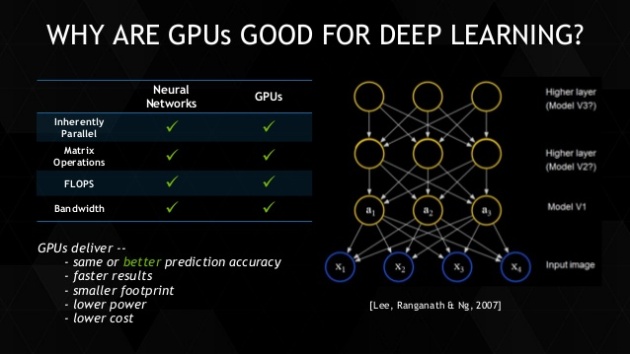
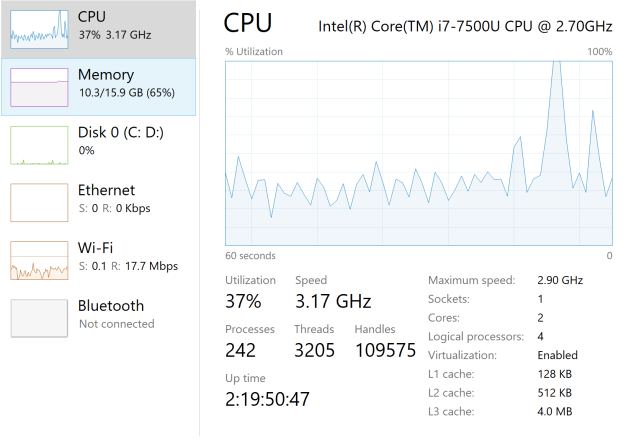
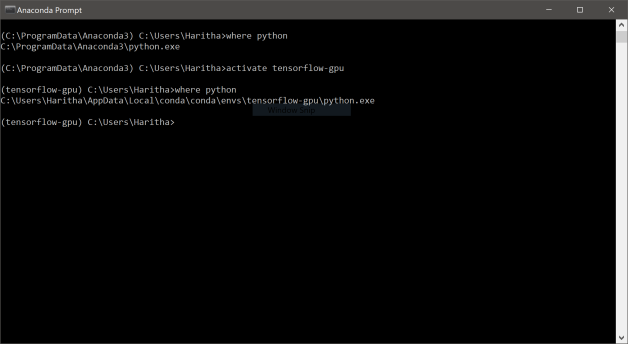
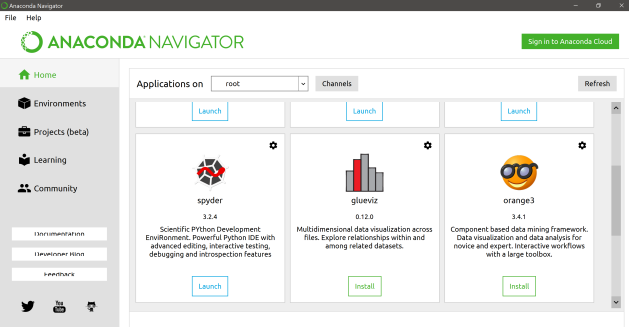
 We have already passed the era of gigabytes when it comes to data. World is talking about terabytes of unstructured data and massive amounts of data points generated from IoT devices and sensors in millions per a second. To analyze these heaps of data, obviously, we need large computation power and massive storage. Building workhorse machines to fulfil those tremendous workloads would definitely cost a lot. Cloud computing paradigm comes handy here. The resourcefulness and the scalability of the public cloud can be used to perform the large calculations in machine learning algorithms.
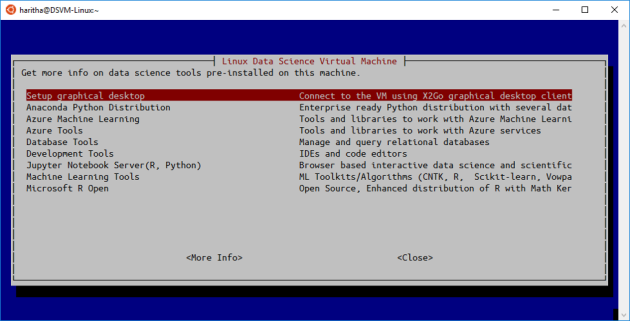 My personal favorite here is the Linux DSVM instance. Here I’ve created a Linux DSVM with the basic configurations. For accessing the VM you can use any tool that can do a SSH call. What I normally do is calling the accessing the VM using Ubuntu Bash on Windows 10.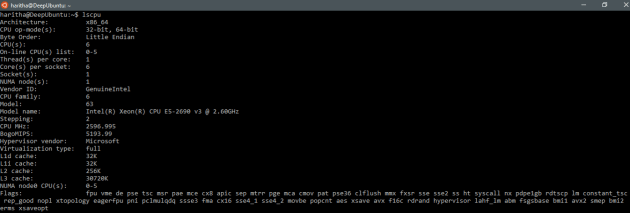
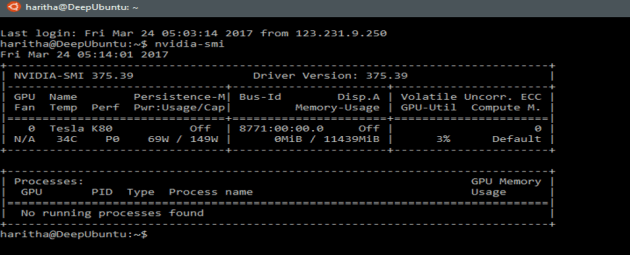
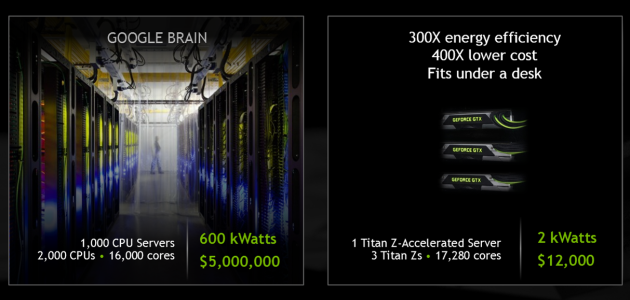

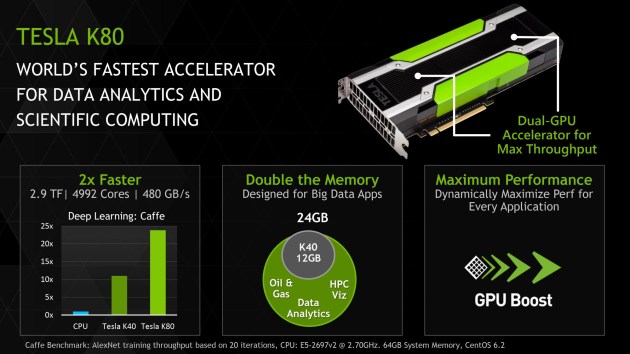 Here’s my Azure VM specifically configured for deep learning exercises. The machine is powered with Tesla K80 GPU which is having 4992 cores in it!! I installed anaconda for that and doing computations using Jupyter notebooks.
 NaadiSpeaks