
What’s all this hype on MLOps? What’s the difference between machine learning and MLOps? Is MLOps essential? Why we need MLOps? Through this article series we going to start a discussion on MLOps to get a good start with the upcoming trend. The first post is not going to go deep with technicalities, but going to cover up essential concepts behind MLOps.
What is MLOps?
As the name implies, it is obviously having some connection with DevOps. So, will see what DevOps is first.
“A compound of development (Dev) and operations (Ops), DevOps is the union of people, process, and technology to continually provide value to customers.”
Microsoft Docs
This is the formal definition of DevOps. In the simpler terms, DevOps is the approach of streamlining application development life cycle of software development process. It ensures the quality engineering and security of the product while making sure the team collaboration and coordination is managed effectively.
Imagine you are a junior level developer in a software development company who develops a mission critical system for a surveillance application. DevOps process make sure each and every code line you write is tracked, managed and integrated to the final product reliably. It doesn’t stop just by managing the code base. It involves managing all development life cycle steps including the final deployment and monitoring of the final product iteratively too.
That’s DevOps. Machine Learning Operations (MLOps) is influenced by DevOps principles and practices to increase the efficiency of machine learning workflows. Simply, it’s the way of managing ML workflows in a streamlines way to ensure quality, reliability, and interpretability of machine learning experiments.
Is MLOps essential?
We have been playing around with machine learning experiments with different tools, frameworks and techniques for a while. To be honest, most of our experiments didn’t end up in production environments :D. But, that’s the ultimate goal of predictive modeling.
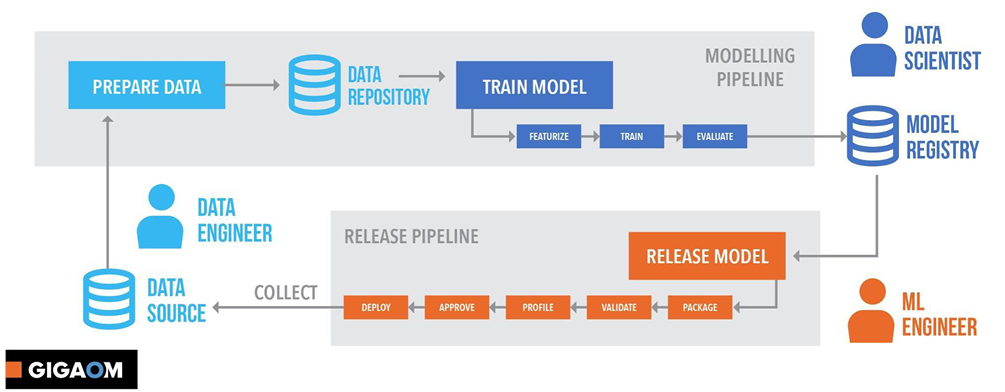
Source : https://azure.microsoft.com/en-au/resources/gigaom-delivering-on-the-vision-of-mlops/
Building a machine learning model and deploying it is not a single step process. It starts with data collection and goes in an iterative life cycle till monitoring the deployed model in the production environment. MLOps approaches and concepts streamline these steps and interconnect them together.
Answer is Yes! We definitely need MLOps!
Why we need MLOps?
As I said earlier, MLOps interconnect the steps in ML life cycle and streamline the process.
I grabbed these points from Microsoft docs. As it implies, these are the goals of MLOps.
- Faster experimentation and development of models
Good MLOps practices leads for more code and component reusability which leads for faster experiments and model development. For an example, without having separate training loops or data loading components for each experiment, we can reuse an abstract set of methods for those tasks and connect them with a machine learning pipeline for running different experiment configurations. That’s make the life easy of the developer a lot!
I do lot of experiments with computer vision. In my case, I usually have a set of abstract python methods that can be used for model training and model evaluation. When performing different experiments, I pass the required parameters to the pipeline and reuse the methods which makes the life easy with less coding hassle.
- Faster deployment of models into production
Machine learning model deployment is always a tricky part. Managing the endpoints and making sure the deployment environment is having all the required platform dependencies maybe hard to keep track with manual processes. A streamlines MLOps pipeline helps to manage deployments by enabling us to choose which trained model should go for production etc. by keeping track of a model registry and deployment slots.
- Quality assurance and end-to-end lineage tracking
Maintaining good coding practices, version controlling, dataset versioning etc. ensures the quality of your experiments. Good MLOps practices helps you to find out the points where errors are occurring easily rather than breaking down the whole process. Will say your trained model is not performing well with the testing data after sometime from model deployment. That might be caused by data drift happened with time. Correctly configured MLOps pipeline can track such changes in the inference data periodically and make sure to notify such incidents.
- Trustworthiness and ethical AI
This is one of the most important use cases of MLOps. It’s crucial to have transparency in machine learning experiments. The developer/ data scientist should be able to interpret each and every decision they took while performing the experiment. Since handling data is the key component of ML model, there should be ways to maintain correct security measures in experiments too. MLOps pipelines ensure these ethical AI principles are met by streamlining the process with a defined set of procedures.
How we gonna do this?
Now we all know MLOps is crucial. Not just having set of python scripts sitting in a notebook it’s all about interconnecting all the steps in a machine learning experiments together in an iterative process pipeline. There are many methods and approaches to go forward with. Some sits on-prem while most of the solutions are having hybrid approach with the cloud. I usually use lot of Azure services in my experiments and Azure machine learning Studio provides a one-stop workbench to handle all these MLOps workloads which comes pretty handy. Let’s start with a real-world scenario and see how we can use Azure Machine Learning Studio in MLOps process to streamline our machine learning experiments.
 NaadiSpeaks